
Emma had studied German for two years. She felt confident about her language skills. This summer, she finally visited Germany. She arrived in Munich on a sunny morning. The city was beautiful and full of life. Emma was excited to practice her German. On her first day, she went to a cafe near her hotel. She wanted to order a simple breakfast. The waiter came and smiled at her. 'Guten Morgen! Was möchten Sie?' he asked. Emma was happy that she understood everything. She looked at the menu and saw the word 'Konfitüre'. It looked very similar to 'confiture' in French. Emma smiled because she knew both languages. This was a true friend word, meaning jam in both languages. 'Ich möchte Brot mit Konfitüre, bitte,' she said proudly. The waiter nodded and brought her order quickly. Emma felt like a real German speaker. Later that day, she went shopping in the old town. She found a beautiful clothing store. A friendly shop assistant asked if she needed help. Emma wanted to say that she was just looking. She thought of the English word 'gift' meaning present. 'Ich suche ein Gift für meine Mutter,' Emma said. The shop assistant's eyes became very wide. She looked shocked and confused. 'Gift? Für Ihre Mutter?' the woman repeated slowly. Emma did not understand why the woman looked so worried. Another customer nearby started to laugh. 'You said you are looking for poison for your mother!' he explained. Emma's face turned bright red with embarrassment. 'Gift' in German means poison, not present! This was a false friend word that tricked her. 'I meant Geschenk!' Emma said, still very red. Everyone in the shop laughed kindly. The shop assistant helped her find a nice scarf for her mother. That evening, Emma wrote about her mistake in her journal. She learned an important lesson about false friends. Words that look similar can have very different meanings. The next day, Emma was more careful with her words. At a restaurant, she saw 'Hamburger' on the menu. She knew this was a true friend word. A hamburger in Germany is the same delicious food as everywhere else. She ordered it without any worry. Emma's trip to Germany taught her many things. Making mistakes is part of learning a new language. And sometimes, those mistakes create the best memories. Emma smiled every time she remembered the poison incident. She would never forget the German word for poison again. That is how a false friend became a true teacher.
English Story (A2)The False Friend Word
aboutStory
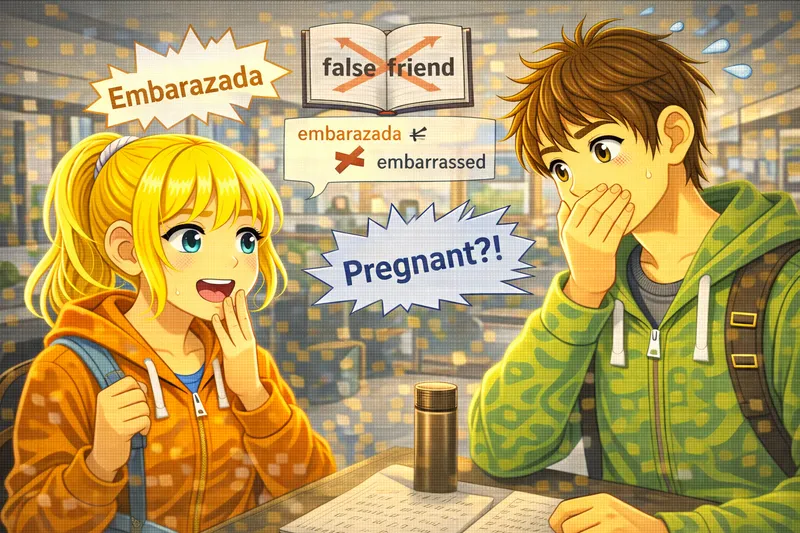
Emma travels to Germany confident in her German skills, but learns about false friend words the hard way. At a clothing store, she accidentally asks for poison instead of a present for her mother, confusing the German word 'Gift' with the English word. Her embarrassing mistake teaches her that similar-looking words can have very different meanings across languages.
1 / 50
🇬🇧→🇬🇧Click any sentence for translation
Translations are shown in the app language, which is also the language of this story. Which language do you speak?
Test your English skills with interactive exercises
Match 10 wordsFill 7 blanksReorder 7 sentencesDictate 7 sentences